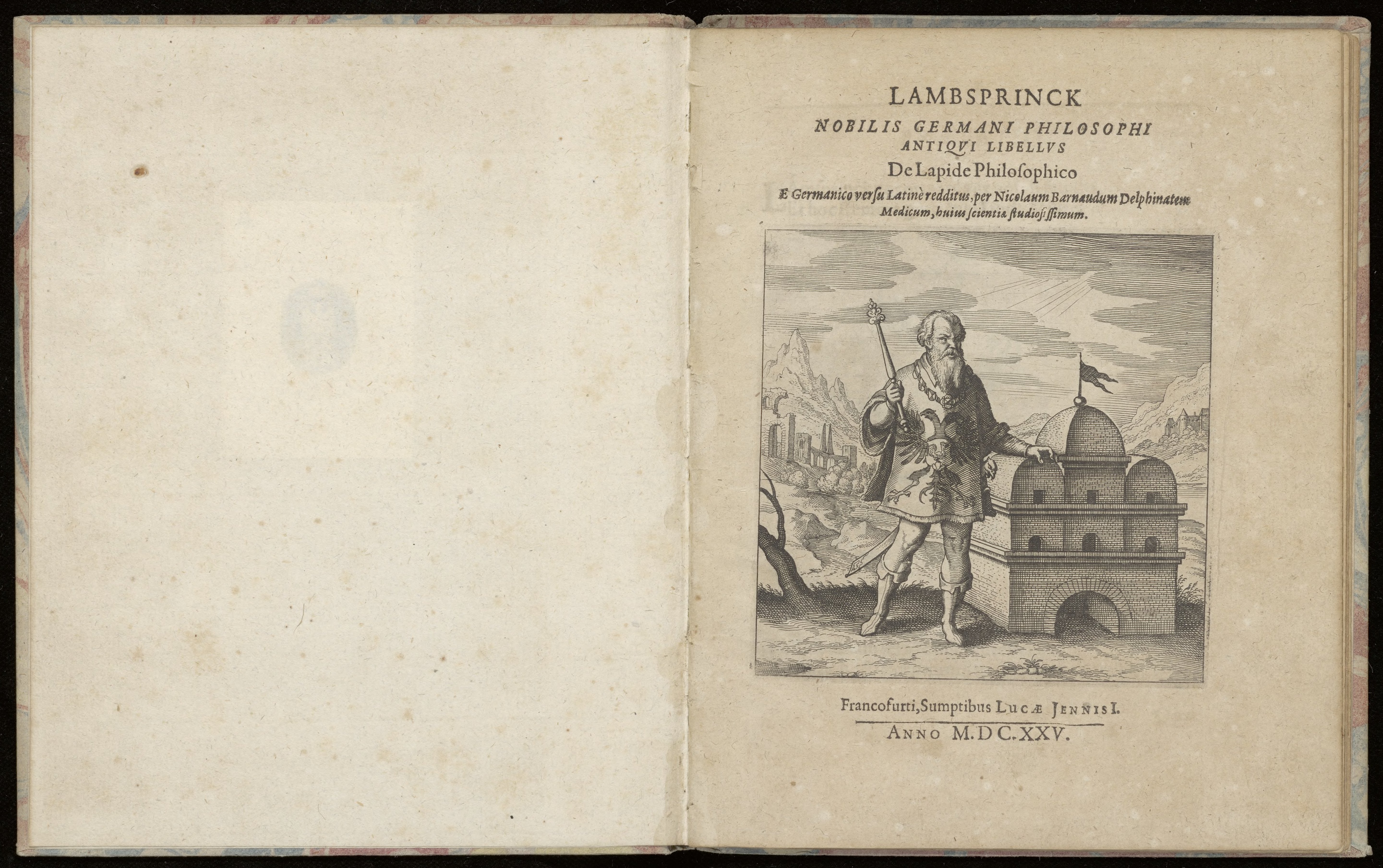
Ask what the Philosopher’s Stone is and you will get a different answer from every alchemist who ever wrote about it. For Lambspringk, it is an allegorical process encoded in fifteen emblems. For Ali Puli, it is the Salt of Nature, improperly called a stone. For Edward Kelly, it is a physical red powder discovered in a bishop’s tomb near Glastonbury. For Bernard of Treviso, it is the thing he spent forty years failing to find.
These are not variations on a theme. They are genuinely different claims about what the Stone is, where it comes from, and what it does. Source Library holds the primary texts behind eight of these accounts — not modern commentaries but the actual printed books, in Latin, German, and English, now translated and annotated for the first time.

I. The Allegory: Lambspringk’s Fifteen Emblems
Lambspringk’s De Lapide Philosophico (Frankfurt, 1625) is the most visually striking alchemical text in Source Library — and perhaps the most honest about what the Stone actually is. Rather than claiming to teach a recipe, Lambspringk presents fifteen allegorical engravings, each accompanied by Latin verse. Two fish in the sea. A stag and a unicorn in a forest. A knight fighting a dragon. An ouroboros. The images build on each other, stage by stage, through the alchemical opus.
The key move is that the “Stone” is never a thing you find. It is a process you undergo. Each emblem represents a stage of transformation in which opposites are united: body and spirit, soul and matter, the volatile and the fixed.
“Pay attention and understand correctly / That two fish swim in our sea. The Sea is the Body, the two Fish are Soul and Spirit.”

The second emblem introduces putrefactio — putrefaction, the necessary death before rebirth. A knight battles a dragon, and the inscription makes the meaning explicit: decomposition is not failure but the precondition of the Work.
“The Philosopher says: There is a wild beast in the Forest, / Entirely covered in blackness. / If anyone cuts off its head, / That blackness will depart, / And a most white color will appear.”
Lambspringk, p. 88 — the nigredo, or blackening stage

By the sixth figure, Lambspringk introduces the ouroboros — the dragon that devours its own tail, the most enduring of all alchemical symbols. This is the moment where matter consumes itself and is reborn:
“This is truly a great miracle and a swift deception, / That in the sea so great a fire lies hidden, / Which devours the fish.”

Lambspringk’s answer to “what is the Stone?” is essentially: it is what happens when you successfully bring these opposites together. The Stone is not a substance. It is the end state of a transformation that the emblems narrate but never reduce to a recipe.
II. The Hidden Root: The Child-Bed of the Philosopher’s Stone
The anonymous German treatise Das Wehmütige Kind-Bett des Steins der Weisen(1692) takes a different approach. Its author, writing under the guise of the legendary Trismosinus addressing his student Paracelsus, insists that the Stone is a “universal root” hidden beneath all manifest nature — and that virtually everyone is looking for it in the wrong place.
“Hold this as a certain rule, that you do not seek this point of nature in the common metals; for you have sufficient reason to believe they are dead, but ours are living.”
The argument is a kind of negative theology: the Stone is not in gold, not in silver, not in any of the common metals. It is not in the shops of apothecaries. It exists prior to the differentiation of matter into the three kingdoms — animal, vegetable, mineral. It is the root from which all three emerge.
“Take it before it has brought forth anything, and while it is still naturally in potentiality… wrapped in a green mantle, covered with a moist night which is nothing other than a hidden light in an unformed Chaos.”
The Child-Bed, p. 5 — the Stone as pre-manifest potential
This is some of the most philosophically sophisticated language in the alchemical literature. The Stone is not a thing but a state — matter at the threshold of manifestation, “still naturally in potentiality.” The image of hidden light in an unformed Chaos reads less like a recipe and more like a creation myth.
III. The Salt of Nature: Ali Puli’s Renamed Stone
Ali Puli’s Centrum Naturae Concentratum (1694) opens with a remarkable subtitle: The Salt of Nature Regenerated, for the most part improperly called The Philosopher’s Stone. The renaming is deliberate. Ali Puli — possibly a pseudonym, attributed to a “Mauritanian born of Asiatic parents” — argues that the name “Philosopher’s Stone” is itself a category error. What the alchemists have been pursuing is the regenerated Salt of Nature, the concentrated center of the natural world.
But Ali Puli’s most striking move is moral, not chemical. The book opens with a warning that amounts to a gatekeeping mechanism:
“Those souls who hunger and thirst after gold deserve to be driven away at the very entrance.”
The English translator’s preface goes even further, describing the treasure as something that “lies hidden deep within themselves” — explicitly relocating the Stone from the laboratory to the interior life. Ali Puli represents the tradition in which the Philosopher’s Stone is less a chemical achievement than a spiritual one: a regeneration of nature’s hidden salt that requires moral purification before it can be found.
IV. Forty Years of Failure: Bernard of Treviso
Bernard of Treviso’s De Chymico Miraculo (Strasbourg, 1583) is the most human document in the alchemical literature — an autobiography of failure. Where most alchemists write as if they possess the secret, Bernard writes as someone who searched for it for the better part of a lifetime, cataloguing his disasters with painful specificity.
He tried eggs. He tried vitriol. He tried dissolving metallic solutions “in the bottoms of vessels for five years.” He distilled toxic substances fifteen times a day for two months and contracted a quartan fever from the fumes — a recurring malarial episode every 72 hours, almost certainly caused by mercury poisoning.
“We distilled what had been poured off fifteen times every day for the space of two months. Because of its most powerful odor, I suffered from a quartan fever.”
He spent vast sums on the advice of a “Master Henry, the Emperor’s Confessor,” who turned out to be a fraud. He wasted thirty marks of silver. He worked himself into physical and emotional breakdown. The text reads less like a manual than like a confession: this is what happens when you take the search seriously and get it wrong, over and over, for forty years.
What makes Bernard’s account significant is that it was published alongside the philosophical tracts. It served as a cautionary tale — the alchemical tradition admitting, in its own voice, that the search could consume a lifetime and produce nothing. The Stone, for Bernard, is defined primarily by its absence: the thing that eluded decades of determined effort.
V. The Powder in the Bishop’s Tomb: Edward Kelly
Edward Kelly’s Alchemical Writings (1893 edition of 16th-century texts) gives us something entirely different: an origin story for a physical substance. According to the biographical preface, Kelly acquired his knowledge of transmutation from a manuscript and two vials of powder — one red, one white — discovered in a bishop’s tomb near Glastonbury.
“The manuscript was kept as a curiosity to be shown to strangers visiting the inn; the undamaged ivory casket became a toy for the innkeeper’s children; a remnant of the red powder happened to be acquired by Kelly.”
Edward Kelly, Alchemical Writings, Biographical Preface, p. xix

The story is vivid, specific, and probably invented. But what matters for our purposes is that Kelly’s Stone is a thing — a physical powder with measurable potency. The biographer claims that in a goldsmith’s laboratory in 1579, Kelly and John Dee accomplished a transmutation of base metal into gold, and that the Tincture’s power was calculated with absurd precision:
“They accomplished a transmutation of metals which proved that the virtue of the Tincture was in proportion of one upon two hundred and seventy-two thousand two hundred and thirty.”
The precision is the tell. One part Tincture to 272,230 parts base metal. This is the language of empirical measurement applied to a claim that cannot be verified — science-shaped rhetoric in the service of an alchemical legend. But it reveals what Kelly’s Stone is: a physical substance, a red powder, with a numerically quantifiable power of transmutation.

VI. The Recipe: Ventura and the Revealer
Lorenzo Ventura’s De Ratione Conficiendi Lapidis Philosophici(Basel, 1571) translates to On the Method of Making the Philosopher’s Stone — and the title is literal. This is a recipe book. Ventura, a Venetian physician, dedicated his work to the Elector Palatine Otto Henry and structured it as a systematic compilation of laboratory procedures drawn from the authorities. Where Lambspringk gives emblems and the Child-Bed gives metaphysics, Ventura gives instructions.
But even Ventura cannot resist acknowledging how crushingly difficult the Work is. His dedication reads like a confession:
“The natural desire for knowing all things given to all by God, best and greatest; second, the sought-after summit of praise and honor; third, the expulsion of idleness — which is like a grave for the living.”
Ventura, De Ratione Conficiendi Lapidis, Dedication — on the three motives for pursuing alchemy
The anonymous Revealer of the Great Secret (1688) goes further still, providing what amounts to a laboratory recipe for the Stone as a red medicinal powder — “potable gold” — complete with ingredients and procedures:
“Pour the living gold over the red lime, and they will immediately be joined together in an inseparable union… And this is the true potable gold.”
What’s remarkable about these recipe texts is how matter-of-fact they are. There is no allegory, no emblem, no moral gatekeeping. The Stone is a red powder. You make it by combining “living gold” (likely a form of dissolved gold or mercury) with a calcined oxide. It can be given to the sick “by itself or mixed with food or drink.” The Revealer treats the Stone the way a medical textbook treats a drug: as a substance with a preparation procedure and a dosage.
VII. Saturn’s Lead: The Saturnian Kingdoms
Huginus à Barma’s Regnum Saturni (“The Kingdoms of Saturn,” 1657, reprinted Paris 1779) puts the emphasis on where the Work begins rather than where it ends. The starting point is Saturn — lead, the heaviest, basest, most despised of metals. The title itself is programmatic: the Stone emerges from the “kingdoms” over which Saturn rules.
The subtitle promises the book is “turned toward the Golden Age” — a dual reference to the astrological age of gold (which Saturn governed in classical mythology) and to the alchemical transformation of base metal into gold. Huginus positions himself squarely within the Hermetic tradition:
“For a long time now, I have known how well Huginus à Barma has served the entire School of the Disciples of Hermes.”
The Saturnian approach is important because it inverts the usual expectations. You don’t start with something precious. You start with lead — the material everyone else throws away. The Stone is hidden in what is most despised, most overlooked, most associated with heaviness and death. This is the alchemical principle of inversion: the last shall be first, the basest shall be noblest, the planet of melancholy shall be the gateway to gold.
The Stone as Mirror
What becomes clear when you read these texts side by side — as Source Library now makes possible for the first time — is that the Philosopher’s Stone functions less as a single concept than as a mirror. What you see in it depends on what you bring.
Lambspringk brings a symbolic imagination and sees allegory. The anonymous author of the Child-Bed brings metaphysics and sees a pre-manifest potential hidden beneath all nature. Ali Puli brings a moral seriousness and sees a spiritual salt that punishes greed. Bernard of Treviso brings a lifetime of honest effort and sees his own failure. Kelly brings a showman’s flair and sees a quantifiable powder. Ventura and the Revealer bring laboratory practice and see a recipe. Huginus à Barma brings the patience of Saturn and sees the gold hidden in lead.

None of these authors are wrong on their own terms. They are writing within different frameworks about a concept that was never standardized. The alchemical tradition had no magisterium, no council to define the Stone’s nature. What it had was a living conversation, conducted across centuries and languages, in which each writer took the inherited symbol and filled it with their own meaning.
The modern reader who asks “but what was the Philosopher’s Stone really?” is asking the wrong question. The right question is: which Philosopher’s Stone? And the answer depends entirely on which book you open.
Primary Sources in Source Library
Lambspringk, De Lapide Philosophico
Frankfurt, 1625 — 15 allegorical engravings with Latin verse
The Child-Bed of the Philosopher's Stone
Anonymous, 1692 — the Stone as universal root
Ali Puli, Centrum Naturae Concentratum
1694 — "The Salt of Nature Regenerated"
Bernhardus Trevisanus, De Chymico Miraculo
Strasbourg, 1583 — forty years of failed experiments
Edward Kelly, Alchemical Writings
1893 edition of 16th-century texts — transmutation claims
Ventura, De Ratione Conficiendi Lapidis
Basel, 1571 — systematic laboratory method
The Revealer of the Great Secret
1688 — recipe for potable gold and the red powder
Huginus à Barma, The Saturnian Kingdoms
1657/1779 — the Stone hidden in Saturn's lead