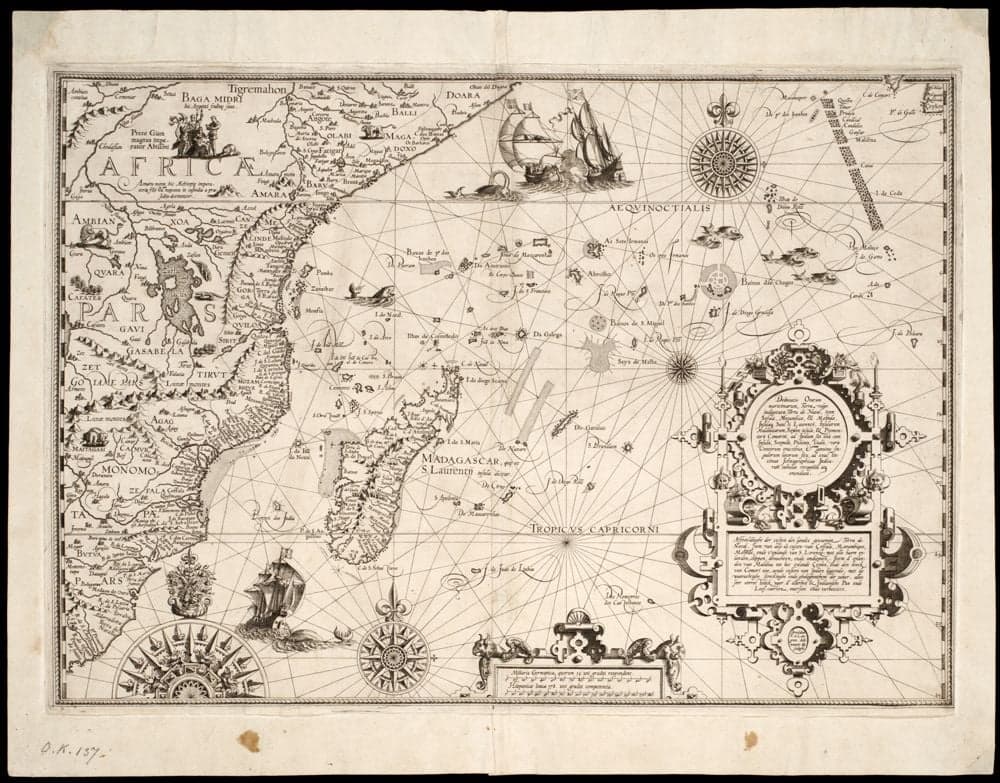
Delineatio orarum maritimarum, Terrae vulgo indigetatae Terra do Natal ... / ad exactissima...
Delineatio orarum maritimarum, Terrae vulgo indigetatae Terra do Natal ... /, ad exactissimas ichnographicas Indicarum tabulas recognita atque emendata = Affbeeldinghe der custen des landts genaempt Terra do Natal, item van alle de custen van Coffala, Mozambique, Melinde, ende t'eylandt van S. Lorenzo: met alle haere eylanden, clippen, droochten, ende ondiepten. Item d'eylanden van Maldiva tot het eylandt Çeylon, ende den hoeck van Comori toe, aende custen van Indien liggende / met de waerachtighe streckinghe ende gheleghentheyt der zelver, alles seer correctelijck naer d'allerbeste Indiaensche pas ende lees-caerten, oversien ende verbeetert / Arnoldus F. à Langren delineavit & sculpsit.
Latin
1596
1 pages
First Translation
No prior complete English translation of this text has been found.
The work in question is a specific nautical map engraved by Arnoldus F. ab Langren, titled 'Delineatio orarum maritimarum', which was included as a plate in Jan Huygen van Linschoten's 'Itinerario' (1596). While the 'Itinerario' itself was translated into English (e.g., by William Phillip in 1598), the map is a visual/cartographic document with Latin inscriptions. There is no evidence of a separate English translation of the map's Latin text, nor is it standard to consider the inclusion of a map in a translated book as a 'translation' of the map itself. Therefore, this specific Latin cartographic work has not been translated into English.
Verified Apr 1, 2026 via local catalogs, google books, internet archive, loc, ustc · methodology
About This Book
geographyhistoryart
Arnoldus Florentius à Langren’s map captures the dangerous transition from Portuguese trade routes to the mysterious interior of East Africa. Readers will uncover how sixteenth-century navigators charted the volatile reefs of the Indian Ocean alongside the legendary political strongholds of Ethiopia.
Pages
OverviewPages
Showing 1 of 1
1