Renaissance & Baroque Music
Zarlino, Mersenne, Kircher, Rameau — the invention of harmony
Illustrations
Browse all60 images extracted from 16 books
This intricate engraving depicts the 'Harmonic Hand,' a traditional mnemonic device adapted by Marin Mersenne to illustrate his complex theories of musical harmony. The hand is integrated into a dense network of diagrams representing tetrachords and musical intervals, reflecting the 17th-century quest to map the mathematical underpinnings of sound onto the human body.
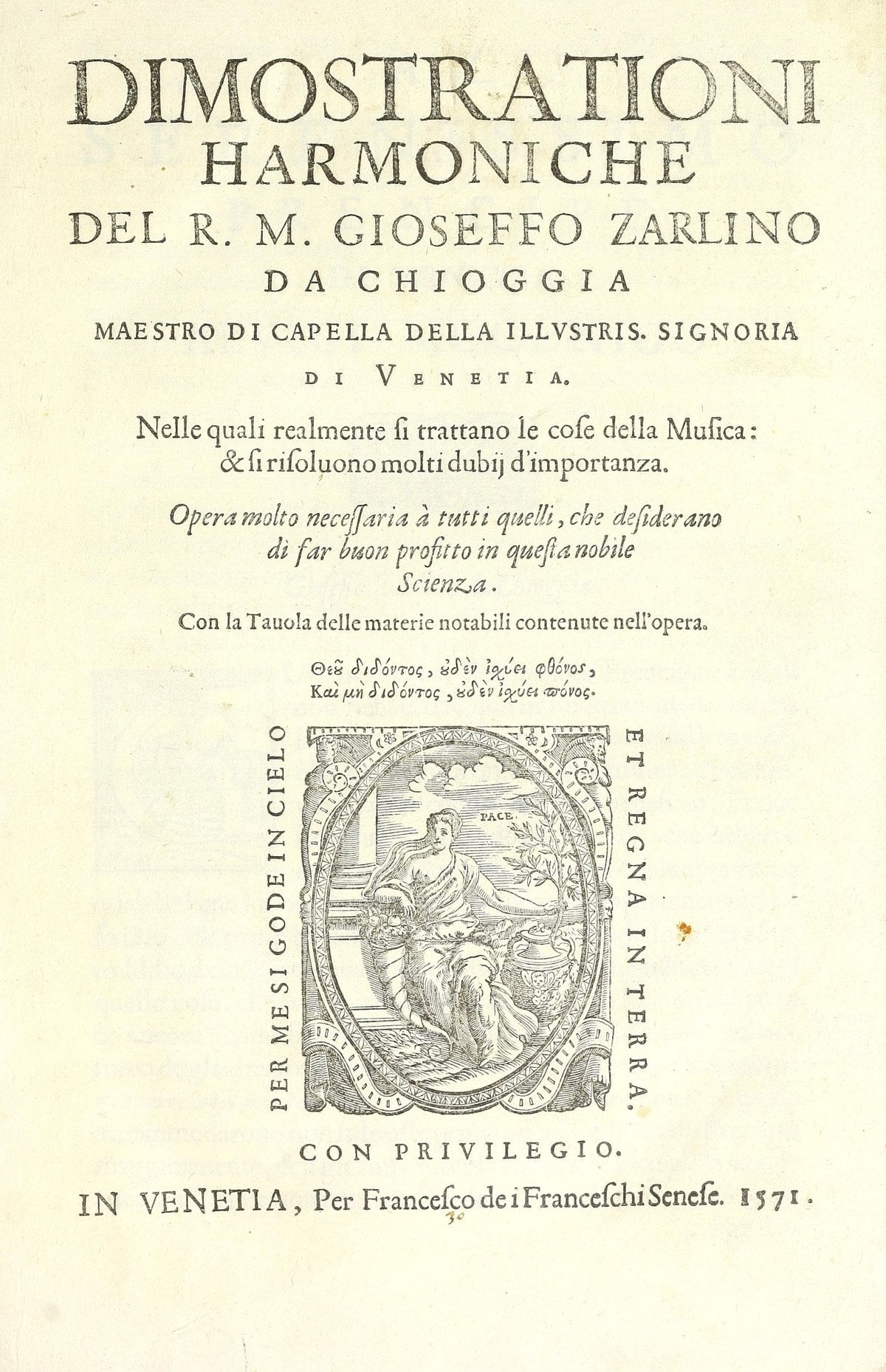
This emblem features the personification of Peace, identified by the inscription 'PACE', seated amidst symbols of prosperity including a cornucopia and an olive branch. The surrounding motto, 'PER ME SI GODE IN CIELO ET REGNA IN TERRA' (Through me one enjoys in heaven and reigns on earth), underscores the divine and earthly importance of harmony. This imagery is particularly significant as it serves as the printer's mark for Gioseffo Zarlino's influential 1571 treatise on musical theory, 'Dimostrationi Harmoniche'.
This iconic engraving from Athanasius Kircher's 'Musurgia Universalis' (1650) represents the creation of the world as a divine musical performance. Six medallions illustrating the days of Genesis are shown as 'harmonies' emerging from the pipes of a grand cosmic organ, reflecting the Baroque concept of a universe ordered by musical principles and the 'eternal wisdom of God' playing upon the world.
This intricate diagram from Marin Mersenne’s 'Harmonie Universelle' (1636) depicts the universe as a musical instrument being tuned by a divine hand. It visually represents the 'Music of the Spheres,' a theory where the proportions of musical intervals are mirrored in the movements of celestial bodies and the structure of the natural world. This image is a quintessential example of how early modern thinkers sought to unify science, music, and faith into a single coherent system.
This engraving from Athanasius Kircher's Phonurgia Nova (1673) illustrates the 'tarantella,' a frenetic dance believed to cure the bite of a tarantula. The scene depicts musicians playing to induce the therapeutic dance in afflicted individuals, reflecting early modern theories on the physiological effects of music. The presence of the spider in the foreground directly links the musical performance to the perceived venomous cause.
This masterful engraving serves as the visual manifesto for Marin Mersenne's 'Harmonie Universelle.' It depicts a figure, likely Orpheus or King David, whose music tames the wild and brings diverse creatures into a state of peaceful coexistence. The scene beautifully illustrates the 17th-century philosophical concept that music is the underlying principle of order and harmony in the natural world.

An elaborate Baroque portrait engraving of Archduke Leopold Wilhelm of Austria, the dedicatee of Kircher's treatise. He is framed by a laurel wreath and surrounded by allegorical figures of Fame and Victory, while a collection of military trophies at the base emphasizes his role as Governor of the Spanish Netherlands. This frontispiece-style illustration serves to glorify the patron through classical and contemporary symbols of power and prestige.

This elaborate engraving depicts Archduke Leopold Wilhelm of Austria (1614–1662), Governor of the Spanish Netherlands, framed by a laurel wreath of victory. He is surrounded by allegorical figures of Fame and putti bearing his heraldic symbols, while a collection of military trophies at the bottom underscores his role as a military leader. The work, engraved by Paulus Pontius after a design by Johann Paul Schor, serves as a grand dedicatory plate for Kircher's monumental work on music.

This intricate frontispiece from Michael Praetorius's 1620 treatise, 'Theatrum Instrumentorum', presents a cosmic vision of music. It depicts earthly musicians and choirs in architectural balconies, their performance harmonizing with the celestial praise of angels and the Lamb of God above. This work is a cornerstone of music history, providing invaluable visual evidence of early modern instruments and performance settings.