


Illustrations
Browse all60 images extracted from 7 books
This elaborate woodcut depicts a monumental classical portal, a key architectural element in Poliphile's dream journey. The structure is adorned with intricate reliefs and medallions depicting mythological scenes and portraits, reflecting the Renaissance fascination with antiquity and architectural theory. It serves as a visual manifestation of the book's complex allegorical narrative.
This intricate woodcut depicts a monumental stepped pyramid topped by a slender obelisk, a key architectural fantasy from Poliphile's dream journey. A winged figure, likely representing Fortune or Fame, crowns the structure, which is framed by ancient, weathered trees. The image reflects the Renaissance fascination with classical antiquity and its symbolic reinterpretation within a dreamlike narrative.
This elaborate hand-colored frontispiece serves as a visual introduction to Ebenezer Sibly's work on medicine and the occult. It depicts a symbolic journey toward enlightenment, featuring Hermes descending with the keys to knowledge above a cavernous path leading to a golden portal. Surrounding the central scene are figures representing the practical and philosophical aspects of the 'occult sciences,' including an alchemist at his furnace and a philosopher guided by a crowned personification of Wisdom.
This intricate woodcut depicts a ritual sacrifice to the god Priapus, a scene from the dream-narrative of Poliphilo. A group of women surrounds the ithyphallic statue under a lush canopy, while in the foreground, an ass is being prepared for sacrifice. This illustration is a prime example of the sophisticated classical revival and eroticized antiquarianism characteristic of the Hypnerotomachia Poliphili, one of the most beautiful and enigmatic books of the early printing era.
This elaborate woodcut depicts a monumental classical portal, a key architectural element in Poliphilo's dream journey. The structure is adorned with intricate reliefs depicting mythological scenes and is topped by medallions featuring profile portraits, reflecting the Renaissance fascination with Greco-Roman antiquity. This illustration is a prime example of the sophisticated woodcut technique used in the 1561 French edition of Francesco Colonna's influential work.
This intricate hand-colored frontispiece serves as a visual gateway to Ebenezer Sibly's work on medicine and the occult. It depicts a central path through a cave toward enlightenment, overseen by the messenger god Mercury and divine symbols, while contrasting the practical work of the alchemist with the contemplative wisdom of the philosopher.

This woodcut presents a Macrobian world map, a classic representation of the Earth's climatic zones as understood in the late Middle Ages and early Renaissance. The map illustrates the known world in the northern hemisphere, separated by a vast equatorial ocean from the 'Antipodes' or unknown southern lands. Encircling the globe are twelve personified wind heads, a traditional iconographic element used to denote cardinal and ordinal directions.

This intricate alchemical emblem presents a visual summary of Hermetic philosophy, centered on the concept of unity ('All in One'). It features the 'squaring of the circle'—a geometric representation of the philosopher's stone—and a salamander in flames, symbolizing the purifying power of fire and the final stage of the Great Work, Rubedo. The Latin mottos emphasize the interconnectedness of the universe and the singular path to spiritual and material transformation.

This intricate woodcut depicts an elaborate allegorical fountain, a central motif in Poliphilo's dream journey. The structure features a three-headed female figure at its apex, likely representing Hecate, surrounded by mythical creatures like dragons and winged sphinxes. This illustration exemplifies the sophisticated blend of classical architecture and arcane symbolism characteristic of the Hypnerotomachia Poliphili, one of the most beautiful and enigmatic books of the Renaissance.
Visual Art
Browse all art →60 works of visual art in this collection
 print
printThe Somnambulist (Mesmerism)
After Chastenet de Puységur
 print
printThe Nightmare (after Fuseli)
After Henry Fuseli (Wellcome Collection)
 painting
The Sleep of Endymion
Anne-Louis Girodet Trioson
 painting
Two Men Contemplating the Moon
Caspar David Friedrich
 painting
The Day Dream
Dante Gabriel Rossetti
 painting
Night
Edward Burne-Jones
 painting
Euphronios Krater (Death of Sarpedon)
Euphronios
 painting
Night and Sleep
Evelyn De Morgan
 painting
Sleep and Death, the Children of the Night
Evelyn De Morgan
 painting
Caresses (The Sphinx)
Fernand Khnopff
 painting
The Sleep of Reason Produces Monsters (Capricho 43)
Francisco de Goya
 painting
Flaming June
Frederic Leighton
 painting
The Dream of Saint Joseph
Georges de La Tour
 painting
Mystery and Melancholy of a Street
Giorgio de Chirico
 painting
Sleeping Venus
Giorgione (completed by Titian)
Every ancient culture knew that the boundary between waking and sleeping was porous — and that what crossed it mattered. The Greeks slept in the temples of Asclepius, waiting for the god to visit them in dreams and prescribe a cure. The Romans classified five species of nocturnal vision, from divine prophecy to meaningless phantasm. The Neoplatonists treated the dream as the soul's gymnasium, the one arena where it could exercise its highest faculties without the drag of the body.
This collection gathers the primary texts on that tradition. Synesius of Cyrene's *On Dreams* (c. 404 AD) is the philosophical summit — a Neoplatonic bishop arguing that dreams are the most democratic form of divination, available to anyone willing to discipline their imagination. Artemidorus's *Oneirocritica* (2nd century AD) is the empirical counterpart: a systematic catalogue of dream symbols tested against thousands of real outcomes. Macrobius's *Commentary on the Dream of Scipio* (c. 400 AD) provides the taxonomy that governed medieval and Renaissance dream theory — five types, from the *somnium* (the enigmatic, symbolic dream that rewards interpretation) to the *visum* (the meaningless hallucination of half-sleep).
Girolamo Cardano's *Four Books on Dreams* (1562) bridges the ancient and modern worlds: a Renaissance polymath recording and analyzing his own dreams with proto-scientific rigour, explicitly building on Synesius. The Abbé Faria's *On the Cause of Lucid Sleep* (1819) traces a line from temple incubation to mesmerism and the first modern theories of hypnosis.
Alongside the treatises, the great dream-narratives: Cicero's *Dream of Scipio*, which sends a Roman general into the stars; the *Hypnerotomachia Poliphili* (1499), the most lavishly illustrated dream-vision ever printed; and the Orphic Hymns to Hypnos and Oneiros, liturgical invocations of the gods of sleep and dreams themselves.
The artworks span three millennia of dreaming — from the Euphronios Krater (515 BC), where Hypnos and Thanatos carry Sarpedon's body from Troy, through Giotto's angel appearing to the sleeping Joachim, Piero della Francesca's nocturnal vision of Constantine, Fuseli's demon-haunted nightmare, to Redon's closed eyes hovering between worlds.
All Books
Browse Full Catalog→106 books in this collection
Aristotle's Psychology: On the Soul and Parva Naturalia
Aristotle (trans. William Alexander Hammond)
On Old Age, On Friendship, On Divination
Cicero
Discourse and Histories of Specters
Pierre Le Loyer
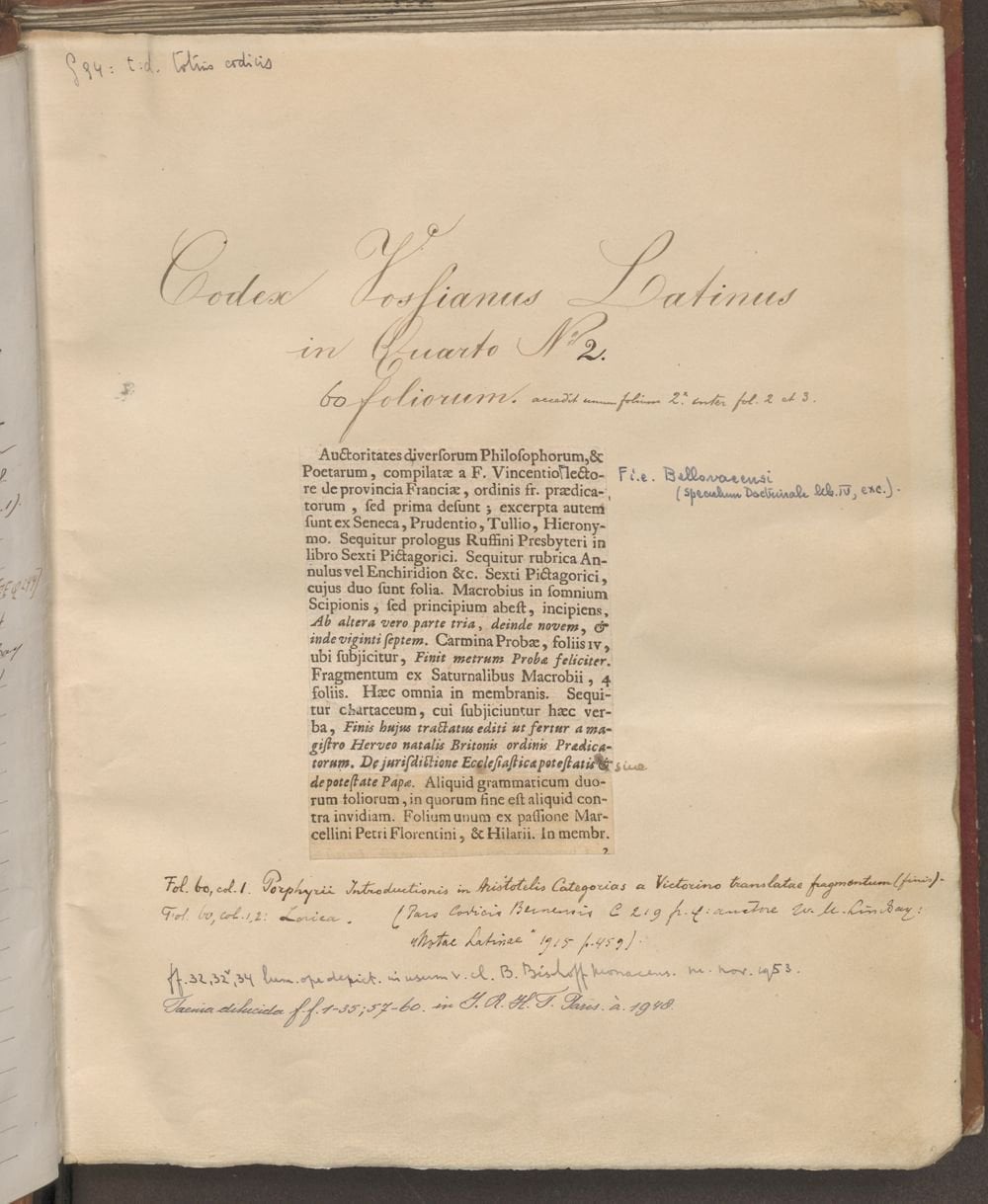
Macrobius, Bede & Pythagoras — 9th-Century Composite MS
Macrobius; Bede; Sextus Pythagoreus; Proba
Philosophical Works of Maine de Biran
Maine de Biran
Iconostasis. Selected Works on Art
Павел Флоренский