
Nicolas Flamel was a real 14th-century Parisian scribe. So was Cornelius Agrippa — the wizard on Chocolate Frog Card #1 of Harry’s collection. So was Paracelsus, Ptolemy, and a turn-of-the-century Russian theosophist named Helena Blavatsky, whom Rowling glances at in the name Cassandra Vablatsky, author of Unfogging the Future.
The books on Dumbledore’s shelves are real too. They sit in libraries from the British Library to the Bibliotheca Philosophica Hermetica in Amsterdam, and most of the important ones are here in Source Library, with modern English translations alongside the originals. We’ve gathered them into a single collection: The Hogwarts Library.
A hundred books, organised by the Hogwarts curriculum. Bestiaries with basilisks and phoenixes for Care of Magical Creatures; herbals with mandrakes for Herbology; alchemical emblem books on the Philosopher’s Stone for Potions; grimoires of charms; demonologies for Defence Against the Dark Arts; Kabbalah and number-mysticism for Ancient Runes. This is the reader’s tour.
I. The wizards who actually existed
Rowling salts the Wizarding World with real historical figures. Most of them turn up first as Chocolate Frog Cards — the collectible cards inside the sweet-shop frogs that Ron empties his pockets of in the Hogwarts Express. Harry’s very first card is Albus Dumbledore. His second is Cornelius Agrippa — described in the card as a “celebrated wizard imprisoned by Muggles for his writing, because they thought his books were evil.”
Heinrich Cornelius Agrippa was a real Renaissance polymath who really did get into trouble for his writing. His Three Books of Occult Philosophy (1533) is the great synthesis of natural magic, celestial magic, and ceremonial magic in the European tradition — the textbook every later magus quotes. You can read the original Latin and an English translation here: De Occulta Philosophia, 1533.
Then there is Paracelsus — physician, magician, and the wizard credited in the books with discovering Parseltongue. (The historical Paracelsus, real name Theophrastus von Hohenheim, taught that knowledge of nature comes from observation rather than authority — less Slytherin than you’d think.) Ptolemy appears on a Chocolate Frog Card too, and his actual Almagest and Tetrabiblos sit in the collection — one for Astronomy class, one for Divination.
The deepest cut is Cassandra Vablatsky — the textbook author for Trelawney’s Divination class, whose name is a soft anagram of Helena Blavatsky, the Ukrainian-born co-founder of the Theosophical Society and the most influential occultist of the 19th century. Her actual books are here: Isis Unveiled (1877) and The Secret Doctrine.
But the wizard you came for is Nicolas Flamel.
II. Potions: the man who really made the Philosopher’s Stone
Flamel lived in Paris from roughly 1330 to 1418. He was a successful manuscript copyist who ran two shops against the wall of Saint-Jacques-de-la-Boucherie. There is no contemporary evidence that he practised alchemy. The legend — that he translated a mysterious Hebrew book of figures, deciphered its secrets after a pilgrimage to Spain, and created the Philosopher’s Stone in 1382 — first appears in print two centuries after his death.
That legend is the basis for the book Harry holds in Chapter 13. And the book in which the legend is told is in Source Library: Le Livre des Figures Hiéroglyphiques de Nicolas Flamel — the 1750 edition of a text first printed in 1612, attributed to Flamel himself, describing the symbols he supposedly read on the walls of the Cimetière des Innocents.
What did the Philosopher’s Stone actually look like, in the alchemical tradition? Source Library has a whole essay on the eight different answers the primary sources give. But the visual answer is unmistakable. Open the Splendor Solis (1598) and you see twenty-two miniature paintings in jewel colours, narrating the Great Work from blackening to whitening to reddening. Open the Mutus Liber (1677) and you find fifteen engravings with no text at all — the Stone communicated entirely in pictures. Open Michael Maier’s Atalanta Fugiens (1617) and you get emblems, epigrams, and fugues for three voices — alchemy as multimedia art.


Books like these are not what most people picture when they hear “alchemy.” They are far stranger and more beautiful. Dumbledore would have been at home here.
III. Herbology: mandrakes, wormwood, and the Garden of Health
Professor Sprout’s greenhouse is essentially the woodcuts of a 16th-century herbal. The mandrake screams when pulled from the ground in Chamber of Secrets — a detail Pliny records in his Natural History, Book XXV, and which the medieval herbal tradition develops with elaborate plates of plants with human faces being uprooted by dogs at the end of ropes.
The book that would have sat open on Professor Sprout’s desk is the Hortus Sanitatis (“Garden of Health”), Mainz, 1491 — a proto-encyclopaedia that catalogues every plant, animal, bird, fish, and stone known to its compiler, with woodcuts that read like the inventory of Fantastic Beasts and Where to Find Them. The first English herbal a working witch or wizard would reach for is John Gerard’s Herball (1597). Nicholas Culpeper’s English Physitian (1653) added astrological correspondences to every plant — the working manual of the cunning folk.
Behind all of these stands Dioscorides, whose De Materia Medica was the foundational European pharmacology for fifteen centuries. The illustrated medieval Pseudo-Apuleius Herbarium (c. 1000 CE) contains the original mandrake plates — the source from which all later screaming-mandrake imagery descends.

IV. Care of Magical Creatures: real bestiaries
Fantastic Beasts and Where to Find Them is, generically, a bestiary. So is British Library Harley MS 4751, a 13th-century illuminated manuscript with entries on the basilisk, the phoenix, the unicorn, the manticore, the parandrus, the cinnomolgus, the yale, and dozens of other creatures Newt Scamander would recognise. Source Library hosts the digitisation.
What about specific Harry Potter monsters? The basilisk — the great serpent of the Chamber of Secrets — has its full natural history in Ulisse Aldrovandi’s Serpentum et Draconum Historiae (1640), which devotes long passages to its lethal gaze and its vulnerability to weasels. Ambroise Paré, the great French surgeon, also wrote a chapter “Of the Basilisk” in his collected Oeuvres (1585).
The phoenix — Dumbledore’s Fawkes — has a foundational late-antique poem, Lactantius’s De Ave Phoenice (c. 300 CE), and a chapter in Aldrovandi’s Ornithologiae. The werewolf appears first in Petronius’s Satyricon (the story of Niceros and the soldier at the tomb) and again, more soberly, in Olaus Magnus’s History of the Northern Peoples (1555), Chapter XLV: “Concerning the ferocity of men converted into wolves.” And dragons permeate the alchemical literature as the ouroboros, the self-devouring serpent of cyclical transformation — visible in Michael Maier’s Scrutinium Chymicum, Emblem XIV.
Hagrid would have read Conrad Gessner’s Historia Animalium (1551) cover to cover — the founding text of modern zoology, in which unicorns and manticores sit alongside cats and goats with the same matter-of-fact tone.
V. Defence Against the Dark Arts: the books you wouldn’t want at home
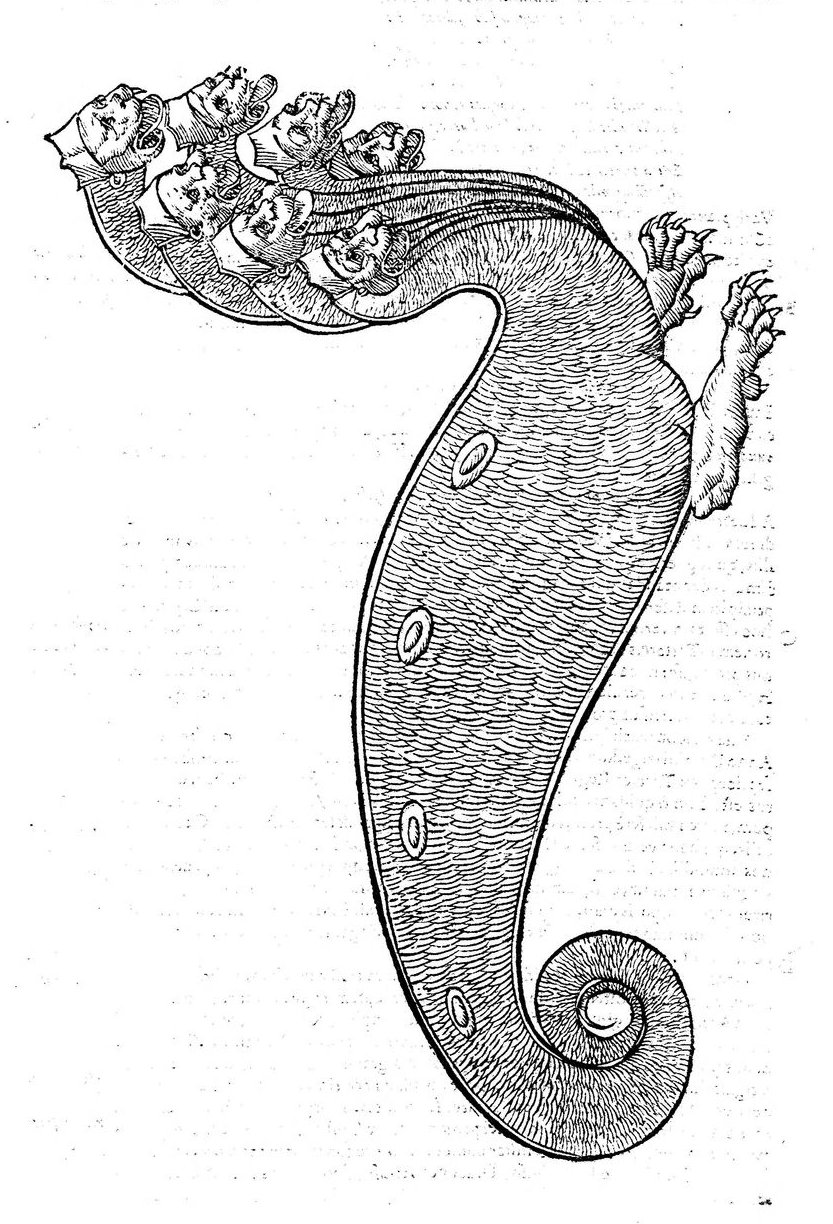
Some of these are difficult books. The Malleus Maleficarum (1486) is the most notorious witch-hunters’ handbook in European history — the manual that prosecutors used for two centuries to send tens of thousands of people, mostly women, to the stake. Its symmetrical counterpart is Johann Weyer’s De Praestigiis Daemonum (1563), a sceptical catalogue of demons whose argumentative purpose was to defend accused witches as melancholic and deluded rather than diabolical.
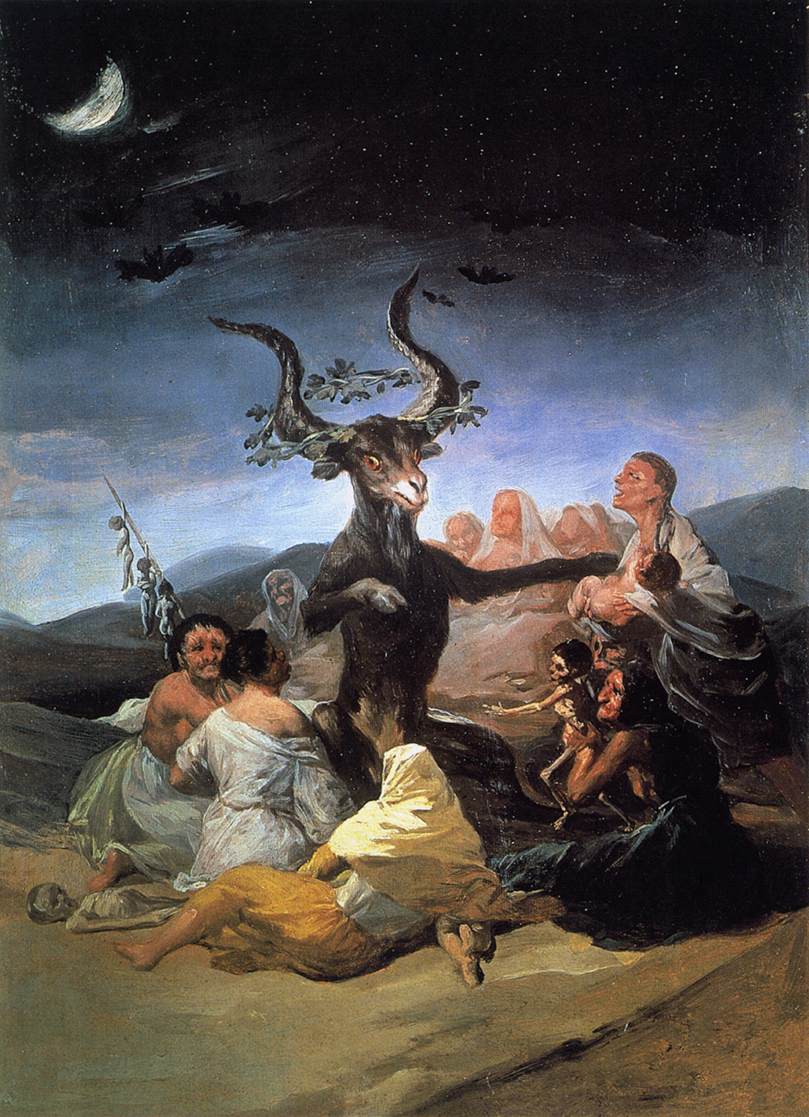
Reginald Scot’s Discovery of Witchcraft went further, exposing stage-magic tricks and ridiculing the witch-trial process. King James I had it burned. (Shakespeare read it; the witches in Macbeth are Scot, not the Malleus.) Francesco Maria Guazzo’s Compendium Maleficarum (1608) is the visual companion — the illustrated demonology, woodcut after woodcut of sabbaths, pacts, and possessions.
For the historical wizarding student, the lesson of this shelf is something like: the wizarding world has always had to live carefully alongside Muggles who were prepared to kill it. Hermione’s textbook on the persecution of medieval witches isn’t a comic invention.
VI. Charms: real grimoires
A “grimoire” is a working spellbook. They were real, they survived in manuscript, and they form a small literature of their own. The most famous is the Key of Solomon (Clavicula Salomonis), attributed pseudonymously to King Solomon, transmitted through 17th-century manuscripts. It contains exhaustive instructions for drawing magic circles, inscribing pentacles, consecrating ritual implements — including the magic wand.
Lower in the hierarchy is the Heptameron of Pietro d’Abano, with its tables of planetary angels and their seals. Higher up is Agrippa’s Three Books of Occult Philosophy, which provides the theoretical scaffolding for everything else.
And further east, drawing on Arabic sources, the Picatrix (Ghāyat al-Ḥakīm) — the medieval handbook of talismanic and astral magic that fed into the Latin Renaissance. The Greek tradition behind all of them is preserved in the Greek Magical Papyri — literal late-antique spell books recovered from the sands of Egypt, complete with love charms, curse tablets, and instructions for summoning a personal daemon.
VII. Divination and Astronomy
Trelawney’s Divination class teaches palmistry, tea-leaves, dream interpretation, astrology, and crystal-gazing — an essentially Renaissance curriculum. For dreams, Artemidorus’s Oneirocritica (2nd century CE) was the standard ancient manual — quoted by Freud as a precursor. For astrology, the working professional’s reference was William Lilly’s Christian Astrology (1647), the great English horary textbook. For prophecy, naturally, Nostradamus.
And for the crystal ball — the Mirror of Erised’s small cousin — we have something extraordinary: A True & Faithful Relation of What Passed Between Dr. John Dee and Some Spirits (1659). John Dee was Queen Elizabeth I’s court astrologer and the most learned man in sixteenth-century England. He spent fifteen years scrying in a black obsidian mirror and a crystal ball, recording the apparitions in his journals, which Meric Casaubon published posthumously. It is the strangest book in this entire collection.

For Astronomy — Professor Sinistra’s class — the standard texts are still in print: Ptolemy’s Almagest, Sacrobosco’s Sphera Mundi, Galileo’s Sidereus Nuncius, Kepler’s Astronomia Nova. Same curriculum, just without the points-for-Gryffindor.
VIII. Ancient Runes & Arithmancy: Kabbalah for beginners
Hermione’s favourite electives — Ancient Runes and Arithmancy — correspond to a real and deep Renaissance tradition: the marriage of Hebrew letter-mysticism with Pythagorean number theory, generally called Christian Kabbalah. The bridge text is Johann Reuchlin’s De Arte Cabalistica (1517), the first major Christian attempt to read Kabbalah as a universal symbolic system of letters and numbers.
Behind it stand the great Hebrew sources: the Sefer ha-Bahir (the earliest Kabbalistic classic), the Sefer Yetzirah (the foundational text on the twenty-two letters and ten sefirot as cosmic principles), and the Zohar with Moses Cordovero’s commentary. Athanasius Kircher’s Oedipus Aegyptiacus (1653) tries to unify all of it — hieroglyphs, Kabbalah, music, magnetism — into a single map of reality. It is the wildest 17th-century book ever written, and exactly the sort of thing you can imagine on the Restricted Section shelf.
IX. The Pensieve is a memory palace
Dumbledore’s Pensieve — the stone basin into which memories can be drawn, preserved, and revisited — is the wizarding-world cousin of a Renaissance art that was taken with deadly seriousness: the art of memory. Robert Fludd’s Utriusque Cosmi Historia (1617) contains the most elaborate diagrams: the Theatrum Orbi, a literal theatre of memory in which the memorist stores ideas at fixed locations on a stage.
Giulio Camillo’s actual L’Idea del Theatro (1555) describes a wooden Theatre he built for the King of France — a memory cabinet with images arranged on seven gradines, representing the entire knowable cosmos. The system descends from Cicero’s De Oratore (45 BCE) and the anonymous Rhetorica ad Herennium (c. 80 BCE), which preserve the method of loci — the technique of remembering by placing ideas at fixed points in an imagined building. Giordano Bruno’s De Umbris Idearum (1582) takes this to a metaphysical extreme: memory as participation in the divine intellect.
The Pensieve, in other words, is what a 17th-century reader would have called ars memoriae — the art of memory — with the magic dialled up but the architecture intact.

X. The Tale of the Three Brothers is older than you think
Beedle the Bard’s most famous tale — the three brothers who meet Death on a bridge and receive the Elder Wand, the Resurrection Stone, and the Cloak of Invisibility — has an exact medieval ancestor. Chaucer’s Pardoner’s Tale (c. 1390) tells of three drunkards who meet Death on a road and end up killing each other over a pile of gold. The structure is identical: three brothers, an unexpected meeting, an irrevocable choice, Death wins.
And the Cloak of Invisibility itself? That goes back to Plato’s Republic (Book II), where Glaucon tells the story of Gyges — the shepherd who found a ring of invisibility on a corpse in a cave, used it to seduce the queen and kill the king, and so opens Plato’s great question: would you behave well if you could not be seen? The Hallows are, in their deepest reading, this same question.
XI. Patronus, polyjuice, horcrux
A few last connections. The Patronus charm — the protective spirit summoned to drive off Dementors — descends from the late-Platonic tradition of the personal daimon. Iamblichus, in his On the Mysteries of the Egyptians (translated by Marsilio Ficino in 1497), describes the guardian daemon assigned to each soul at birth, a being summoned through theurgic prayer. Plutarch’s De Genio Socratis in the Moralia (1509 edition) gives the same idea its most famous philosophical defence.
Polyjuice Potion — the brew that turns the drinker into another person — has a direct literary ancestor: Apuleius’s Golden Ass (2nd century CE), in which the protagonist watches a witch transform herself with an ointment and then, taking the wrong jar, accidentally becomes a donkey. The novel ends with his initiation into the mysteries of Isis — transformation, in Apuleius, is always about something deeper than appearance.
And horcruxes — soul-anchors that allow a wizard to fragment and hide parts of their own being — resonate with the Kabbalistic doctrine of the three souls: nefesh (the animal soul), ruach (the spirit), and neshamah (the higher soul). The Cabalistic Disputation on the Soul (Israel ben Moses, 1635, held by the Bibliotheca Philosophica Hermetica) is one of the classic treatments. Voldemort’s sin, on this reading, is to do violently and for selfish reasons what the contemplative tradition does carefully and for sacred ones — distinguish the levels of the soul.
Read them yourself
Rowling once said in an interview: “I’ve never wanted to be a witch, but an alchemist, now that’s a different matter. To invent this wizard world, I’ve learned a ridiculous amount about alchemy.” The books she would have read, and the books her wizards would have read, are largely the same books. They are in this collection.
What Source Library adds — and what no Harry Potter / alchemy article on the internet has ever offered — is the actual texts in modern English, end to end, alongside the originals, free, with every page searchable. The British Library can show you a manuscript page; we let you read the book.
Twelve highlights from the collection
Nicolas Flamel, Hieroglyphic Figures
1750 (text from 1612) — the legend in his own attributed voice
Mutus Liber
1677 — fifteen wordless engravings of the Philosopher's Stone
Splendor Solis
1598 — 22 illuminated miniatures of the Great Work
Michael Maier, Atalanta Fugiens
1617 — alchemy as emblems, epigrams, and three-voice fugues
The Ripley Scroll
c. 1450 — a 6-metre illustrated alchemical manuscript
Hortus Sanitatis
1491 — the proto-bestiary and herbal in one volume
British Library Harley MS 4751
13th c. — illuminated bestiary with basilisks, phoenixes, unicorns
The Key of Solomon
17th c. — the working grimoire that consecrates the wand
Cornelius Agrippa, De Occulta Philosophia
1533 — Chocolate Frog Card #2, real text
Malleus Maleficarum
1486 — the witch-hunters' handbook
William Lilly, Christian Astrology
1647 — the great English horary textbook
Robert Fludd, Utriusque Cosmi Historia
1617 — the Pensieve's ancestor: the art of memory