In October 2025, Joel Mokyr shared the Nobel Prize in Economics with Philippe Aghion and Peter Howitt for work on the “prerequisites for sustained growth through technological progress.” The committee cited Mokyr’s insight that the Industrial Revolution depended not just on incentives or institutions, but on a culture that valued “useful knowledge” — propositional knowledge about nature that could be turned into prescriptive knowledge about technique.
Mokyr’s framework raises an obvious question: how far back does that culture go? He traces it from the Enlightenment forward, through the Republic of Letters and the Industrial Enlightenment. But he has always acknowledged that the evidence gets thin before 1700, not because the knowledge didn’t exist, but because most pre-modern texts on natural philosophy, alchemy, mechanics, and experimental method were written in Latin, German, Arabic, and Hebrew — and have never been translated into English.
That gap is now closing. Source Library holds over 2,500 books from the 2nd to 19th centuries, drawn from fourteen digital library collections. Over 500,000 pages have been translated into English, and over 1,200 of these books are first-ever English translations — texts that have existed for centuries but had no prior English version. What they contain confirms and extends the central insights of progress studies: the culture of useful knowledge has deeper roots than anyone could previously read.
I. What the Frameworks Predicted
The remarkable thing about progress studies is how well its frameworks predict what we found in the pre-1750 sources — sources that were unavailable when the frameworks were built.
Mokyr argued that sustained growth requires a culture that produces “useful knowledge” — systematic understanding of natural phenomena that practitioners can turn into working techniques. He built this case from Enlightenment-era evidence. But the pre-1750 texts show exactly this dynamic: alchemists systematically studying the properties of matter, natural philosophers developing theories of pneumatics and hydraulics, instrument-makers accumulating practical knowledge about furnaces, distillation, and metallurgy — all producing propositional knowledge and turning it into prescriptive technique.
Anton Howes argued that innovation is driven by the spread of an “improving mentality” — a learned cultural disposition, spreading person to person, characterized by “a belief in the acceptability of contesting tradition” and “a vision of the benefits of progress.” He traced it through British inventor networks starting in the 1540s. The translated texts show that this mentality existed centuries earlier — it just lived under different names and in different languages. Howes was right about the mechanism. The timeline goes back further than he could see.
Jason Crawford has been building the case for a “techno-humanist” philosophy — the view that technological progress and human flourishing are connected, not opposed. The pre-industrial texts are full of this conviction. Renaissance natural philosophers believed that understanding nature’s secrets was a path to human improvement. The alchemist’s project was explicitly about perfecting nature through knowledge. They were techno-humanists before the term existed.
II. What’s in the Books
Source Library holds over 2,500 books from the Embassy of the Free Mind and thirteen other digital library collections, spanning the 2nd to 19th centuries. Most are in Latin, German, Dutch, French, Italian, Arabic, and Hebrew. Over 500,000 pages have been translated into English.
The collection was assembled for the study of Western esotericism — alchemy, Hermeticism, Kabbalah, astrology, natural magic. But when you actually read these texts, the boundary between “esotericism” and “proto-science” dissolves. The same books that describe the philosopher’s stone also describe how to build furnaces. The same author who writes about divine illumination also gives specifications for a kite. The same manuscript that contains Hermes Trismegistus also contains Hero of Alexandria’s steam engines.
We documented this in detail in “The Hidden Engineers” — every claim linked to the original translated page. Here is a summary of the evidence.
Steam engines in a spell book
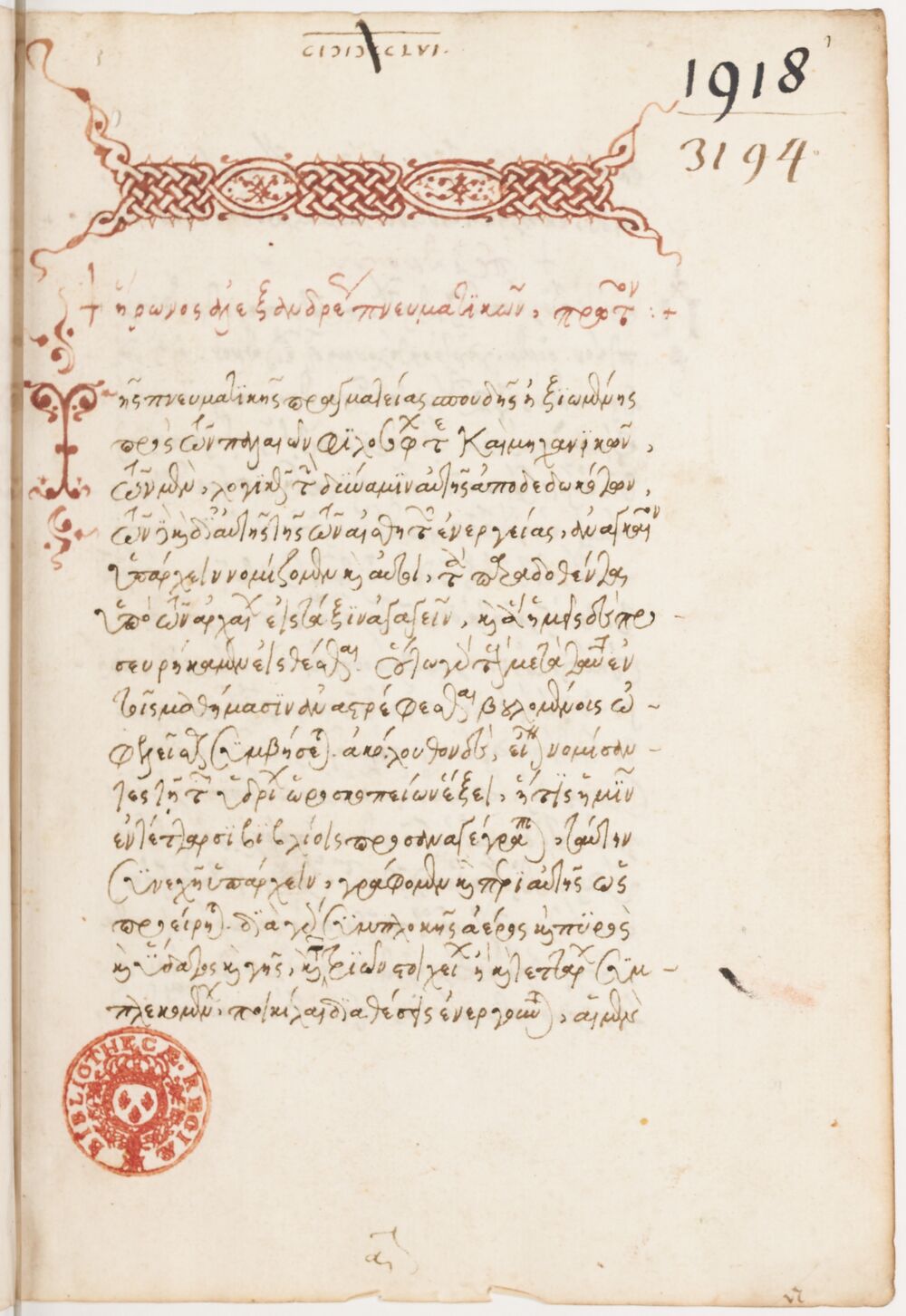
A manuscript copied for King Francis I of France around 1545 binds two works in the same volume: Hero of Alexandria’s Pneumatica — describing steam-powered rotating spheres, automatic temple doors, and singing bird automata — and the Corpus Hermeticum, the foundational text of Western mystical philosophy. The same scribe, the same royal binding. The aeolipile diagram is sixty pages from the vision of divine light.
Pneumatics as “natural magic”
Giambattista della Porta’s Magia Naturalis (1589) promises “natural magic” and delivers a pneumatics textbook. Book XIX is a systematic treatment of hydraulics and air-pressure devices, citing Hero by name. Book XX gives exact specifications for building a kite — frame proportions, covering materials, wind conditions — and concludes that “the ingenious man will be able to foresee the principles by which even a man might be able to fly.”
The alchemist’s laboratory equipment
Alchemists were the best-equipped experimental chemists in Europe for over a thousand years. They invented the athanor — a self-feeding furnace that maintains constant temperature for days, solving a real thermodynamics problem before thermostats existed. The bain-marie, attributed to Maria the Prophetess in late antiquity, survives in every chemistry laboratory and restaurant kitchen in the world. The Theatrum Chemicum (1659) — six folio volumes, over two hundred treatises — scatters precise technical instructions for building laboratory equipment among its alchemical allegories.
A literal steam engine schematic in a Rosicrucian manuscript
Pages 58–59 of Die Lehren der Rosenkreuzer contain what may be the most unexpected document in the collection: a construction plan for a steam-powered device, labeled “Elijah’s Chariot.” It includes materials (red brick, iron plate, angle iron bands), measurements (scale of three-quarters of an inch to the foot), and functional components (exhaust flue, water/steam chamber). The Rosicrucian author took a biblical image of divine ascension and solved it as an engineering problem.
III. The Improving Mentality Goes Back Further
Howes’s thesis is elegant: innovation spreads like a cultural disposition, person to person, through networks of people who believe that things can be made better and that making them better is worthwhile. His evidence starts in 1547. But the mechanism he describes is visible centuries earlier in the translated texts — it just hadn’t been readable in English before.
Alchemy was, at its core, an explicit program for improving nature. The transmutation of base metals into gold was not just a metaphor for spiritual perfection — it was a technological ambition. Alchemists believed that nature’s processes could be accelerated, perfected, and surpassed through systematic investigation and experiment. The philosopher’s stone was imagined as a technology: a substance that would perfect any material it touched.
This is not a retrospective interpretation. The texts say so explicitly. Roger Bacon (13th century) argued that “experimental science” was the highest form of knowledge. Ramon Llull developed a combinatorial logic machine in the 1270s. The Arabic alchemist Jābir ibn Hayyān (8th century) described a systematic program for understanding and manipulating the properties of matter. These figures had Howes’s two characteristics — they contested tradition and they envisioned benefits from doing so — centuries before the British improving networks he documents.
The reason this wasn’t visible is the language barrier. The improving mentality before 1547 lived in Latin, German, and Arabic texts that had never been translated. You cannot trace person-to-person diffusion of a cultural disposition through texts you cannot read. Now you can.
“In the mechanical arts, the first inventor falls shortest, and time adds to and perfects the work; but in the sciences, the first author goes furthest, and time degrades and corrupts.”
Francis Bacon — writing in 1605, within Howes’s time frame — described what had already been true for centuries. The “mechanical arts” were cumulative: each generation improved on the last. The blacksmith improves while the philosopher declines. Bacon was not inventing this observation. He was naming something that alchemists, instrument-makers, and natural philosophers had been doing for generations — in Latin, German, and Arabic texts that are now, for the first time, readable in English.
IV. Newton, Boyle, and the Source Code
Progress studies has long grappled with the question of why the Scientific Revolution happened where and when it did. The answer, increasingly, involves what the revolutionaries were reading — and most of it was in the esoteric tradition.
Isaac Newton spent more time on alchemy than on physics. His alchemical manuscripts — over a million words — were hidden for centuries, dismissed as an embarrassment. They are now recognized by historians (William Newman, Lawrence Principe) as central to his intellectual development. Newton’s concept of gravity as action at a distance — the idea that Leibniz mocked as “occult qualities” — drew on traditions of sympathetic action that were commonplace in alchemical and Hermetic texts.
Robert Boyle, whose The Sceptical Chymist (1661) is often treated as the founding document of modern chemistry, was an active alchemist. His experimental method grew directly from alchemical practice. Boyle believed that laboratory experiments “in search of a way to transform base metals into gold… often had value in themselves as exercises in investigation.”
Johannes Kepler believed that planets were alive. His Astronomia Nova (1609) — in which he discovered that planetary orbits are elliptical, not circular — was driven by a conviction that the cosmos had a harmonic structure. He described gravity as a “mutual material tendency between related bodies” eighty years before Newton, but also wrote that planets had an “animal faculty” guiding their motion. The elliptical orbit and the living planet came from the same intellectual framework.
The intellectual tradition out of which modern science emerged is preserved in the texts that Source Library holds. The Theatrum Chemicum, the Artis Auriferae, the Hermetic and Neoplatonic texts that Ficino translated, the Kabbalistic works that shaped Renaissance natural philosophy — these are the source code of the Scientific Revolution. Understanding why progress happened means reading what the people who made it happen were reading.
V. The Theatre of Machines
Beyond the esoteric tradition, Source Library holds a growing collection of explicitly technical works — the “theatre of machines” genre that flourished from the 15th to 17th centuries. These are the handbooks that Howes’s improvers were learning from.
Agostino Ramelli’s Le diverse et artificiose machine (1588) is the most famous: 195 copperplate engravings of water-lifting devices, mills, bridges, and military machines, each with detailed technical descriptions. Georgius Agricola’s De re metallica (1556) is a 600-page treatise on mining and metallurgy — the most comprehensive technical manual of the 16th century. Vannoccio Biringuccio’s De la pirotechnia (1540) is the first systematic treatment of metallurgy, pyrotechnics, smelting, and gunpowder.
Konrad Kyeser’s Bellifortis (c. 1430) — the most important medieval military technology manuscript — catalogs siege engines, early firearms, diving equipment, and incendiary devices. Niccolò Tartaglia’s Nova scientia (1537) founded the science of ballistics by applying mathematics to projectile trajectories. Simon Stevin’s Geometrie(1586) introduced decimal fractions to Europe and laid the foundations of statics and hydrostatics.
Brian Potter’s The Origins of Efficiency (2025) traces how modern engineering emerged from accumulated craft knowledge. These machine theatres are the missing early chapters of that story. Some have partial English translations from the 19th or 20th century; many have never been fully translated. All are now searchable and readable in Source Library.
VI. Translation as Innovation Infrastructure
Progress studies already knows that translation is infrastructure. The most frequently cited example is the 12th-century Toledo School of Translators, where scholars translated Arabic texts on mathematics, astronomy, medicine, and philosophy into Latin. This transfer — from Arabic to Latin, from Islamic civilization to medieval Europe — provided the foundation for the European scientific tradition. Euclid, Ptolemy, Aristotle, Galen — much of the Greek corpus reached Europe through Arabic intermediaries and Latin translation.
Mokyr’s “Republic of Letters” is another translation story: a network of scholars sharing knowledge across national boundaries, made possible by a common language (Latin, then French and English) and a culture of open correspondence. The diffusion of useful knowledge depended on people being able to read it.
The same bottleneck exists today, in reverse. Thousands of pre-1800 texts in Latin, German, Arabic, and Hebrew have been digitized and sit in open-access library collections. They are “available” in the sense that anyone can view the page images. They are unavailable in the sense that almost no one alive can read them.
AI removes this bottleneck. The full pipeline — digitization, OCR, translation, indexing — costs approximately $1.90 per book and takes minutes. Source Library processed its first thousand books in December 2025. It passed 2,500 in March 2026. Of these, over 1,200 are first-ever English translations — texts that have existed for centuries but have never been accessible to anglophone researchers. The methodology is documented and verifiable.
This is itself a progress studies case study. The bottleneck was not knowledge of the texts’ existence, or lack of interest, or insufficient funding for conventional translation. The bottleneck was that the cost of translation exceeded the economic value of any individual text. No publisher would commission a scholarly translation of an obscure 1572 Latin alchemical treatise for a market of perhaps two hundred readers. But when the marginal cost of translation approaches zero, the calculus changes. You translate everything and let readers find what matters.
The parallel to Collison and Cowen’s framework is direct. They argue that we need to understand the mechanisms of progress well enough to produce more of it. One mechanism — perhaps the oldest one — is making existing knowledge readable. The Toledo translators did it in the 12th century by moving Arabic to Latin. Gutenberg did it in the 15th by reducing the cost of copying. We are doing it in the 21st by reducing the cost of translation.
VII. The Corpus Is Open
The scale of the translated corpus changes what questions are possible. With a handful of translated texts, you can write a case study. With thousands, you can do statistical analysis. How often do alchemical treatises include technical specifications for laboratory equipment? How does the vocabulary of “experiment” evolve across centuries and languages? Where do mechanical and mystical descriptions co-occur, and where do they separate? These are questions that require a corpus, not a monograph — and the corpus now exists.
For progress studies specifically, the opportunity is to extend the evidence base backward. Howes’s improving mentality did not appear from nowhere in the 1540s. It had precursors in the alchemical tradition, in the theatre of machines, in the natural magic that was really experimental physics. Mokyr’s useful knowledge circulated in Latin and Arabic centuries before the Republic of Letters made it available in vernacular languages. Source Library makes those precursors legible.
The full collection is searchable and free. Every translation links back to the original page image. The first translations are flagged. The engineering evidence is documented with primary source citations. The API is open for researchers who want to work with the texts programmatically.
Collison and Cowen ended their 2019 essay by asking: “How do we improve our ability to generate useful progress?” One answer, at least, is straightforward: read what the improvers were reading. The books are open.
Further Reading
The Hidden Engineers
Steam engines in spell books, automata in alchemy, kites in natural magic
First English Translations
Over 1,200 texts translated into English for the first time
First Translation Methodology
How we identify and verify first-ever English translations
The Mystic Who Discovered Planetary Motion
How Kepler's occult beliefs led to modern astronomy
We Need a New Science of Progress
Patrick Collison and Tyler Cowen, The Atlantic (2019)
The Origins of Efficiency
Brian Potter on how engineering emerged from craft knowledge (Stripe Press, 2025)
Newton the Alchemist
William Newman on Newton's alchemical manuscripts (Princeton UP)
Age of Invention
Anton Howes's newsletter on the history of innovation
The Techno-Humanist Manifesto
Jason Crawford's vision for progress and human flourishing